Buying solar lights across borders involves more than checking brightness, battery size, or panel wattage. A product may look reliable in a sample room, then fail after weeks of rain, heat, or repeated charging. Experienced buyers inspect test reports, production controls, labeling, and after-sales evidence together. The central question is simple: What certifications should high-quality solar lights have? The answer depends on the destination market, product design, and installation environment.
For outdoor luminaires, buyers often review testing aligned with relevant IEC 60598 requirements and verify the claimed IP rating under IEC 60529. EMC evidence matters when lights include remote controls, sensors, or wireless functions. In the European market, CE marking requires appropriate conformity assessment, while RoHS addresses restricted substances. In the United States, FCC requirements may apply to electronic or radio-enabled products. Lithium batteries may also need transport documentation, including UN 38.3 testing. ISO 9001 can support confidence in factory processes, but it does not certify every product.
Look beyond logos.
A credible supplier should provide traceable reports, model numbers, laboratory details, and clear validity dates. Ask whether the report covers the exact lamp, battery, controller, and configuration being purchased. This point is often missed. A certificate for an older model may not support a redesigned product. IP claims also need context, because installation quality and aging seals can change real-world protection. No certification guarantees flawless performance. Strong sourcing combines recognized standards, independent testing, factory audits, warranty records, and practical checks under local weather conditions. Certification lists can guide decisions, but careful verification remains essential.
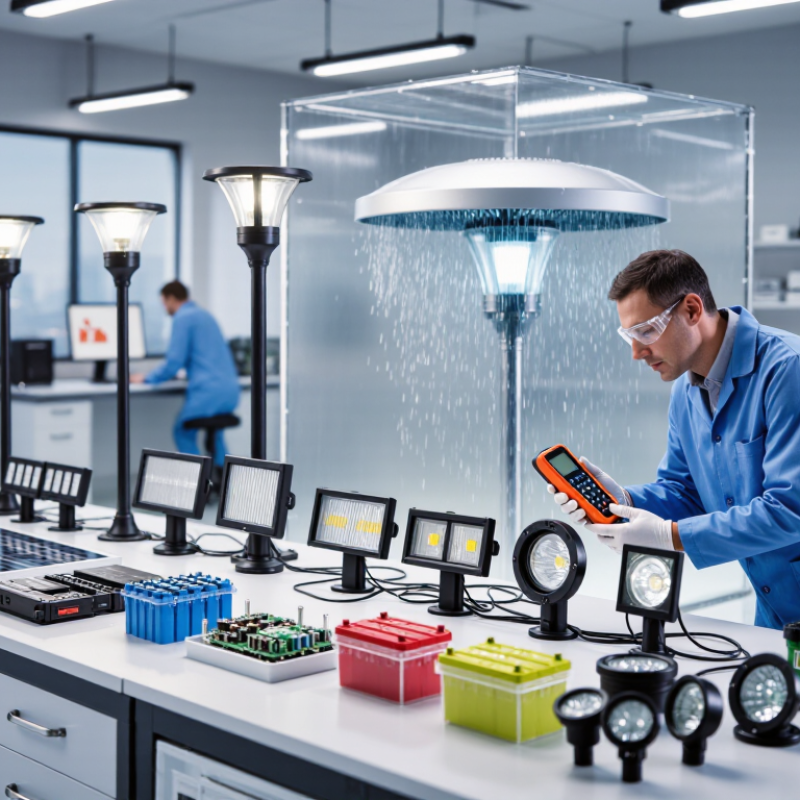
Solar light certifications are documented proof that a product has been tested against defined safety, performance, or environmental requirements. They may cover electrical safety, electromagnetic compatibility, material restrictions, water resistance, or battery transport. A certificate is not a decorative badge. It should identify the tested model, standard, factory, test date, and issuing laboratory.
Global buyers need these documents because solar lights often enter markets with different rules. A streetlight may require electrical safety testing, while a garden lamp may face chemical restrictions and radio interference limits. CE-related compliance can support sales in European markets, but it is not one universal approval. Other regions may request local marks, accredited test reports, or supplier declarations. Requirements can also change.
In procurement work, I check whether the certificate matches the exact model, battery type, charging system, and production site. Small differences matter. An outdoor rating may describe water resistance, not complete product safety. A report from an unknown laboratory deserves closer review. Certificates can also expire, or cover an earlier design. Paperwork helps, but it cannot replace sample testing, wiring inspection, and field checks after rain and repeated charging. I have seen compliant files hide practical weaknesses, such as dim output during cloudy weeks or loose seals around the battery compartment. Buyers should treat certification as evidence, not a guarantee.
Top Solar Light Certifications for Global Buyers?
Certification planning should begin with the target market, not the factory checklist. IRENA’s Renewable Capacity Statistics 2024 recorded 447.5 GW of new solar capacity in 2023. That scale increases buyer scrutiny, especially for outdoor lighting used in public and residential spaces. European Union imports commonly require CE compliance, electromagnetic compatibility testing, and RoHS substance controls. Low-voltage products may also need electrical safety assessment. Wireless control features can create additional radio requirements. The exact route depends on voltage, battery design, and communication functions.
In North America, buyers often request recognized electrical safety testing, electromagnetic compatibility evidence, and reliable battery documentation. The United States may require FCC authorization for wireless electronics. Canada can apply separate national requirements. Australia and New Zealand commonly use electrical compliance schemes for applicable equipment. Weather exposure also matters. An IP rating under IEC 60529 describes protection against dust and water, but it does not prove long-term outdoor durability. IEC 62471 testing can help evaluate photobiological safety. Requirements are not always neatly separated.
Tips: Match each claim to a test report, declaration, or certificate. Check the model number, test standard, laboratory scope, and report date. IRENA’s 2024 statistics show rapid solar expansion, but market growth does not reduce compliance risk. Ask whether testing covered the complete luminaire, battery, charger, and controller. A familiar certificate can still be incomplete. Recheck requirements before shipment, because standards and national interpretations change.
Common regulatory checkpoints by target market for solar-powered outdoor lighting products
Top Solar Light Certifications for Global Buyers?
Which Safety and Performance Standards Apply to Solar Lights
Solar lights must meet safety, electrical, and environmental requirements in their target markets. IEC 60598-1 covers general luminaire safety, including insulation, wiring, heat resistance, and protection against electric shock. Outdoor models often require IEC 60598-2-3 for road and street lighting applications. For water and dust protection, buyers should check the IP rating under IEC 60529. An IP65 enclosure, for example, resists dust and water jets, but it is not designed for immersion.
The solar panel, battery, charger, and control circuit need separate attention. Photovoltaic modules may follow IEC 61215 and IEC 61730 requirements for durability and electrical safety. Lithium batteries usually need transport testing under UN 38.3. Electromagnetic compatibility testing can involve IEC 61547 and CISPR 15. Regional marks, such as CE or UKCA, may also require technical files and conformity declarations. Requirements differ by destination.
A certificate alone can mislead. It may cover one model, one battery type, or an earlier design. Buyers should compare the report number, tested sample, rated power, battery chemistry, and production date. Check the laboratory’s accreditation, too. In practical inspections, loose seals and weak connectors often create greater risk than visible cosmetic faults. Some suppliers provide excellent paperwork but limited evidence of long-term outdoor performance. Thermal cycling, repeated charging, and salt-spray testing deserve closer review, especially for coastal installations. The details are easy to overlook.
A certificate is useful only when its details match the product you will receive. For solar lights, check relevant safety standards, such as IEC 60598 requirements. Regional marks may also apply, but approval rules differ by destination. Do not treat one certificate as global permission. It rarely works that way.
Ask the supplier for the complete certificate, not a cropped image. Confirm the certificate number, issuing body, product model, factory address, issue date, and expiry date. Contact the issuing organization through its official website. A test report should identify the exact sample, test method, results, and laboratory accreditation. The laboratory should normally follow ISO/IEC 17025 principles. Check every page. Small inconsistencies matter.
Review performance claims with equal care. Compare stated lumens, battery capacity, panel power, charging time, and operating hours. Request test conditions, including temperature, brightness mode, and battery age. A twelve-hour claim may use a dim setting. That detail changes the buying decision.
Also inspect IP ratings, corrosion testing, and battery safety evidence when outdoor use is expected. Supplier documents can be genuine yet incomplete. I have seen buyers verify a certificate but overlook model differences. That mistake is easy to repeat.
When evidence conflicts, pause the order and request an independent sample test. A careful process may feel slow, but unclear paperwork costs more later.
Top Solar Light Certifications for Global Buyers
How Certification Status Affects Solar Light Purchasing Decisions
Certification status often determines whether a solar light enters a serious purchasing list. Buyers need more than a confident sales claim. Relevant IEC testing can indicate electrical and performance controls, while CE or UKCA documentation supports market access in applicable regions. RoHS evidence addresses restricted substances. Wireless models may also require radio-emission compliance. These documents influence trust, cost, and delivery planning.
Outdoor use needs closer attention. An IP65 test result suggests protection against dust and water jets under defined conditions. It does not guarantee survival during every storm. Battery safety records, charging tests, and transport documents deserve equal review. A valid file should identify the exact model, factory, test date, standard, and testing laboratory. A logo alone proves little.
Procurement teams should compare certificate scope with the shipped product. Small changes in battery type, solar panel, or housing can make old documents less useful. Independent laboratory reports are stronger when buyers can verify their reference numbers. Field details matter too: muddy paths, winter shade, salt air, and repeated impact may expose weaknesses that paperwork misses. Certification reduces uncertainty, but it cannot replace sample testing or installation feedback. That is the uncomfortable part. A product can pass a test and still disappoint users. Request a current sample, inspect seals, measure overnight lighting, and record battery performance after several cloudy days.
| Certification, Marking or Standard | Main Market or Use | Typical Solar Light Relevance | What Buyers Should Verify | Influence on Purchasing Decisions |
|---|---|---|---|---|
| CE Marking | European Economic Area and other markets that recognize relevant EU conformity requirements | May apply to electrical and electronic components, electromagnetic compatibility, radio equipment, batteries and other applicable product legislation | EU Declaration of Conformity, applicable directives or regulations, technical documentation, test reports and product-label consistency | High for market access; a CE mark alone is not proof of independent third-party certification |
| UKCA or Accepted UK Conformity Route | Great Britain, subject to the product category and current UK legislation | Relevant to electrical products and other regulated equipment placed on the applicable UK market | Applicable UK regulations, declaration of conformity, marking rules, importer details and required conformity-assessment evidence | High when selling into Great Britain; requirements should be checked for the shipment date and product type |
| FCC Part 15 Compliance | United States for applicable unintentional or intentional radiators | Important for solar lights containing switching electronics, wireless controls, sensors, chargers or communication modules | Correct FCC equipment authorization or supplier’s declaration route, EMC test reports, labeling and user information | High for US compliance; relevance depends on the electronics and radio functions included |
| RoHS Compliance | European Union and markets using comparable restricted-substance rules | Applies to restricted substances in electrical and electronic equipment, including circuit boards, cables, solder and components | Material declarations, supplier evidence, risk-based test records and a product-level compliance statement | High for regulated markets and sustainability-focused procurement programs |
| REACH Compliance | European Union chemical-safety market requirements | Relevant to substances in plastics, coatings, cables, batteries, adhesives and other articles or components | Current substance declarations, information on substances of very high concern where applicable and supply-chain documentation | Medium to High depending on materials, sales channel and buyer policy |
| IEC CB Scheme | International product-safety test evidence used by participating certification bodies | Can support acceptance of relevant luminaires, power supplies, control gear and other electrical equipment against applicable IEC standards | CB test report, CB certificate, product model scope, applicable IEC edition and any national deviations | High for multi-country sourcing because it can reduce duplicated safety testing, but national approval may still be required |
| IEC 60598 Series | International technical reference for luminaires | Covers general luminaire safety and relevant requirements for fixed, portable, outdoor or other luminaire types | Test report matching the exact luminaire construction, LED module, battery system, charging circuit and installation conditions | High for technical due diligence; it is a standard series rather than a universal market-access certificate |
| IP Rating to IEC 60529 | International ingress-protection classification | Especially important for outdoor solar lights exposed to dust, rain, irrigation and temporary water contact | Accredited or competent laboratory report, tested configuration, enclosure design and whether the rating applies after installation | High because the rating directly affects durability expectations and warranty risk |
| IK Rating to IEC 62262 | International impact-protection classification | Useful for public areas, pathways, parking areas and installations exposed to accidental or deliberate impact | Impact-test evidence, enclosure material, lens construction and confirmation that the tested model matches the supplied product | Medium to High for commercial, municipal and security-sensitive projects |
| UN 38.3 Battery Transport Testing | International transport of lithium-ion and other applicable lithium batteries | Relevant when solar lights contain lithium batteries shipped separately or installed in the finished product | UN 38.3 test summary, battery identification, packaging information, transport classification and required shipping documents | High for logistics feasibility, freight cost, customs processing and shipment acceptance |
| ISO 9001 Quality Management System | International supplier quality-management assessment | Supports controlled production, traceability, corrective action and consistency across batches | Valid certificate scope, certification-body accreditation, site coverage and certificate validity | Medium; it evaluates the management system, not the safety or performance of a specific solar light |
Buyer note: Certification needs depend on the destination market, product configuration, battery chemistry, wireless functions, installation environment and applicable local legislation. Always match documents to the exact model and supplied components.
IEC 60598-1 covers general luminaire safety. It addresses insulation, wiring, heat resistance, and electric shock protection.
IP65 resists dust and water jets. It does not protect against immersion. Do not place it underwater.
Inspect the panel, battery, charger, and control circuit separately. Each component may require different safety evidence.
Check the battery chemistry, capacity, test records, and production date. Lithium batteries may require UN 38.3 transport testing.
Request the complete document. Check the certificate number, model, factory address, issuing body, dates, and tested sample.
Usually, no. Requirements differ by destination. One certificate may cover only one model or battery type.
It should show the exact sample, test method, results, and laboratory accreditation. ISO/IEC 17025 principles are useful to review.
Compare lumens, battery capacity, panel power, charging time, and operating hours. Ask about temperature, brightness mode, and battery age.
Loose seals and weak connectors can cause serious problems. Coastal projects also need salt-spray and corrosion testing.
Pause the order and request an independent sample test. Slow checking feels inconvenient, but unclear paperwork costs more later.
Solar light certifications help global buyers assess whether a product is safe, reliable, efficient, and suitable for its intended market. The question “What certifications should high-quality solar lights have” depends on the destination country, product type, installation environment, and applicable technical requirements. Buyers should review certifications related to electrical safety, electromagnetic compatibility, battery protection, ingress resistance, lighting performance, and environmental durability, while also confirming whether local or regional standards apply.
Certification status should be evaluated alongside product specifications, testing reports, warranty terms, and supplier documentation. Buyers should verify certificate numbers, issuing laboratories, testing dates, product models, and the exact scope of approval rather than relying only on logos or promotional statements. A complete and traceable certification record can reduce compliance risks, support customs and project approval, and improve confidence in long-term performance. Ultimately, certification is one important purchasing factor, but it should be considered together with quality control, technical suitability, after-sales support, and total operating cost.

Midmo Lights