Choosing solar lights is not just a style decision. Color temperature changes how a path, porch, or garden feels after sunset. Warm white often looks soft and amber-like; cool white appears cleaner and more blue-toned. What is the difference between warm and cool white solar lights? In practical terms, it is mainly the light’s color appearance, measured in kelvins—not a direct measure of brightness or solar performance.
ENERGY STAR’s lighting guidance commonly groups warm white around 2700–3000K and cool white around 3500–4100K. The U.S. Department of Energy’s 2022 Solid-State Lighting R&D Opportunities report also treats color quality and energy efficacy as distinct lighting considerations. That distinction matters. A cooler-looking fixture is not automatically brighter, more efficient, or longer-lasting. For solar lights, panel exposure, battery capacity, weather, and the product’s controls all affect nightly runtime. DarkSky and the Illuminating Engineering Society’s Five Principles for Responsible Outdoor Lighting recommend using light only where needed, directing it carefully, and favoring warmer colors outdoors. This is useful guidance for a front path or patio, where glare can bother neighbors and obscure the quiet feel of a garden. Still, product labels vary, and a stated color temperature cannot tell the whole story. Check the beam pattern, brightness rating, and battery details too. The label can mislead. A small sample light in the actual space may reveal more than a product photo.
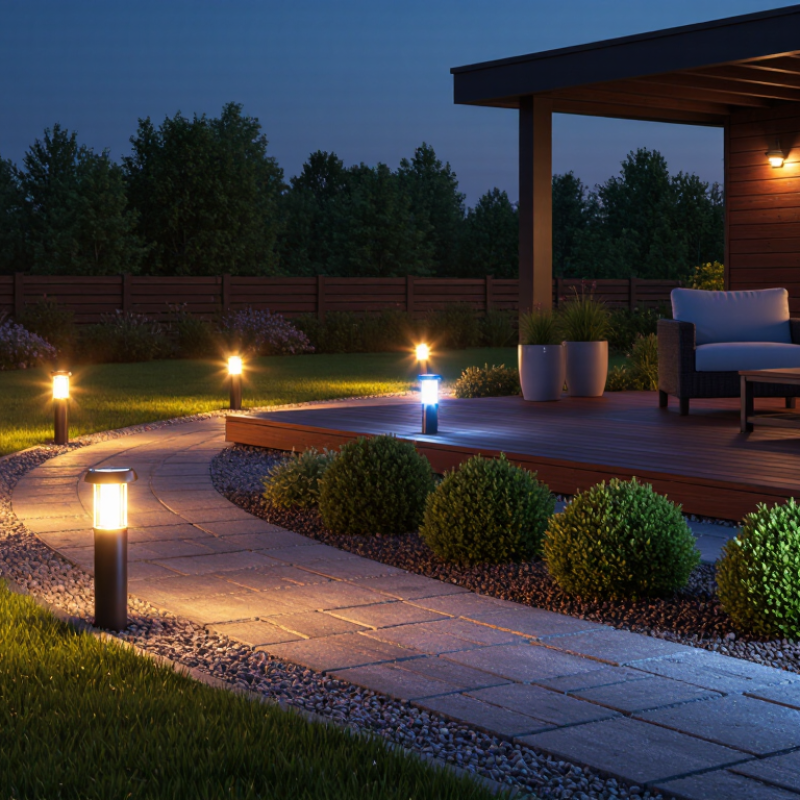
Warm white solar lights are commonly specified at 2700–3000 K. Their amber-toned glow makes timber, stone, and garden foliage feel softer after sunset. Cool white typically falls between 5000 and 6500 K, producing a bluer, sharper appearance. These are correlated color temperature (CCT) values, not brightness readings. CIE 15:2018, the International Commission on Illumination’s colorimetry standard, provides the technical framework for measuring color appearance in kelvins. The ranges above are common product specifications, not a claim that every lamp within a range looks identical.
Look closely at the setting. A 2700 K path light can make a small patio feel relaxed, while a 6000 K fixture can reveal texture more clearly near steps or a work area. But higher CCT does not automatically mean more usable light; compare lumens and beam angle too. Solar-light output also changes as the battery discharges, so color and brightness may not stay consistent through the night.
Check a product’s measured CCT and test it at dusk against the actual wall or paving. I find cool white can feel overly stark beside warm indoor windows—though that contrast may suit some spaces. A small difference matters.
Warm white and cool white describe color appearance, not brightness. The U.S. Department of Energy’s LED Basics guide distinguishes luminous flux, measured in lumens, from color characteristics. Compare lumens under similar test conditions. Solar lights can dim as their batteries discharge, so a peak-output figure alone may not reflect a full evening outdoors. Check the stated runtime and charging conditions. Small detail, big difference.
CRI runs from 0 to 100, but it does not measure brightness. CIE’s 13.3-1995 method calculates general CRI, Ra, from eight color samples; ENERGY STAR criteria set an 80 minimum for covered lamp categories. Treat that as a benchmark, not a guarantee that every surface will look natural. Beam angle matters too: a narrow beam makes a brighter pool on a path, while a wider beam spreads light across steps. Ask whether the angle is measured at half peak intensity, and compare like with like. IES LM-79 describes laboratory measurements of solid-state lighting, but real solar performance still depends on charge and installation. A specification can still mislead.
Warm white and cool white describe light color, not solar capacity. To compare solar lights, check panel wattage, battery capacity in watt-hours (Wh), and stated runtime together. A higher-wattage panel can collect energy faster in strong sunlight, but shade, panel angle, and short winter days reduce the actual harvest. The printed rating is a useful starting point, not a daily guarantee.
Battery capacity helps estimate how long a light can run after dusk. For example, a 12 Wh battery powering a 2-watt lamp suggests about six hours in ideal conditions. Real runtime is usually lower because the light’s electronics use energy, and the battery may not deliver all its rated capacity. Check whether the listed runtime applies to the brightest setting or a dimmer mode. Small print matters.
For a practical comparison, match the panel and battery figures with the brightness setting you expect to use. A warm-white model may feel softer near a patio table; cool white can make a path look sharper. Neither color automatically means longer runtime. I’d treat very generous runtime claims cautiously, especially when no brightness level or test conditions are given. A few cloudy days can change the picture.
For solar lights in China, choose CCT after checking the actual light on the ground. Warm white, often around 2700–3000 K, can feel gentler near seating and bedroom windows. Cool white, commonly around 4000–5000 K, can make steps and garden edges appear crisper. But CCT does not tell you how bright a path is. Measure horizontal illuminance at the surface, in lux, after dark; panel charge, battery state, and mounting height all affect the result. Small detail. It changes the comparison.
CIE 150:2017 sets pre-curfew vertical-illuminance limits of 2 lux for the darkest environmental zone and 5 lux for the next zone. These are limits on light spilling toward surrounding spaces, not recommended path-light targets. Measure vertical lux at a window or eye position as well as horizontal lux on the path. A bright cool-white beam can feel glaring when it shines directly into someone’s eyes, even if the ground reading looks modest. Shielding and aiming matter.
For a doorway, steps, or a frequently used walkway, prioritize even coverage and visible edges over a “whiter” appearance. For a patio or planting bed, warmer light may suit the setting, provided people can still see obstacles clearly. Compare both colors at the same measured lux and viewing angle. I would not judge from a product photo; phone cameras distort color and brightness. It is an imperfect test, but a lux meter and a walk-through at night give a more useful answer.
Typical outdoor lighting planning ranges by intended use. The bars show lux ranges, not a guaranteed output from any particular light.
How to use this chart: Warm white (about 2200–3000 K) often suits paths, steps, and relaxed porch areas; neutral to cool white (about 3500–5000 K) can suit task-focused areas. These are practical preferences, not fixed rules. CCT does not determine illuminance: check lux at the surface and distance where the light will be used. Beam angle, mounting height, and obstructions also affect the reading. Ranges are general planning guidance, not universal standards.
Warm white solar lights, usually around 2700–3000K, make a porch feel softer. Cool white, often near 5000–6500K, can make steps and garden edges look clearer. Color preference matters, but it cannot confirm a product’s performance. China-market listings may show impressive lumen ratings that are difficult to compare without test conditions.
Check photometric data measured with consistent equipment and setup. A lumen figure describes total light output; a lux reading describes light reaching a particular surface. Compare lux at the same distance and angle, ideally after the light has operated for several hours. A bright first reading can fade quickly. That matters.
Battery claims need similar scrutiny. Record charging conditions, then measure runtime at night until the light dims or switches off. Repeat the test, since clouds, panel angle, temperature, and battery age can change results. Warm and cool versions may also use different power settings, so compare them at matched brightness when possible. Small differences count.
A neat specification sheet is not proof. Ask for the test method, sample count, and raw readings, not just a star rating. If independent data is unavailable, treat the rating as a clue, not a guarantee. One limitation remains: home tests are useful, but rarely as controlled as laboratory measurements.
Warm white is commonly 2700–3000 K, with an amber glow. Cool white is often 5000–6500 K and appears bluer. These figures describe color appearance, not brightness.
Not necessarily. Compare lumens, beam angle, and measured lux. A higher color temperature alone does not mean more usable light.
Warm white can make timber, stone, and garden foliage feel softer. It may also feel gentler near seating and bedroom windows. The result depends on the space.
It can make steps, path edges, and work areas appear crisper. Check that the beam does not shine into people’s eyes.
Compare them at the same measured lux and viewing angle. Check horizontal lux on the paving, then look at coverage and beam angle.
Its output may fall as the battery discharges. Charging conditions and mounting height also affect the light on the ground. Peak output tells only part of the story.
No. CRI describes how accurately colors appear, using a scale from 0 to 100. A high score does not guarantee every surface will look natural.
Aim the fixture away from eyes and windows, and use shielding where needed. Check vertical light near windows as well as light on the path.
Phone cameras can distort color and brightness. Test it at dusk against your actual paving or wall. Not perfect, but more useful.
Choosing between warm white and cool white solar lights depends on where and how the light will be used. What is the difference between warm and cool white solar lights? Warm white typically ranges from 2700–3000 K, creating a softer, more relaxed appearance, while cool white usually ranges from 5000–6500 K and looks brighter and more neutral or bluish. Color temperature alone does not determine performance: compare lumens for light output, CRI on a 0–100 scale for color accuracy, and beam angle for how widely the light spreads.
Also consider the solar panel’s wattage, the battery’s capacity in watt-hours, and the expected runtime after charging. Match the chosen color temperature to measured illuminance in lux, the level of glare, and the intended setting, such as a pathway, patio, or work area. For products sold in China, check available photometric measurements and battery test data rather than relying only on advertised brightness or runtime.

Midmo Lights